
2026 Nobel Prize in Chemistry: Henri B. Kagan, who has close scientific ties with the ICN
- Research
Published on May 20, 2025
–
Updated on October 14, 2026
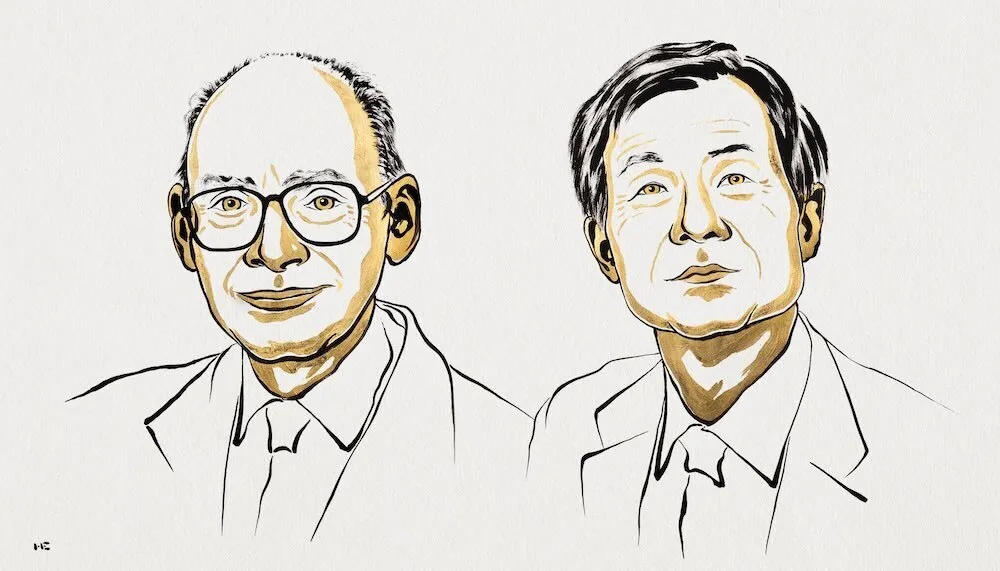
Henri B. Kagan was awarded the Nobel Prize in Chemistry in 2026. Several groups and researchers at the ICN have drawn inspiration from his work on stereochemistry or have collaborated directly with him. Here’s how his research has had an impact as far afield as Nice.
Elisabet Duñach, former director of the ICN, was a postdoctoral researcher in H. Kagan’s team. She played an active role in his work on non-linear effects in asymmetric synthesis and is proud to be a co-author of their renowned joint publication from 1986 in the *Journal of the American Chemical Society*.
The current director of the ICN, Uwe Meierhenrich, first met H. Kagan in June 2001. At the time, he was conducting synchrotron experiments at LURE, in Paris-Orsay. As the synchrotron staff had gone on strike – a strike linked to the development of the new Soleil synchrotron – the irradiation experiments were suspended. U. Meierhenrich took advantage of this period to get in touch with H. Kagan. Later, in May 2008, H. Kagan wrote the foreword to his book *Amino Acids and the Asymmetry of Life*. M. Meierhenrich’s supervisor, Professor W. Thiemann, had first taken an interest in the problem of homochirality in 1957, during a lecture by Professor Huisgen in Munich. Since then, he had remained in regular contact with H. Kagan, both sharing a keen scientific interest in chirality.
Henri Kagan’s work in chemistry has been a source of inspiration for all those involved in asymmetric catalysis, including Véronique Michelet’s group ‘Catalysis and Methods for Organic Synthesis and Fine Chemistry’, thanks to his discovery of the DIOP ligand (a derivative of tartaric acid), the first chiral C2-symmetric diphosphine ligand effective in asymmetric catalysis, which forms complexes with metals such as Pd, Rh, Ru or Au. Dr V. Mamane proposed a special issue dedicated to Professor H. Kagan, entitled ‘A Wonderful Journey in the Asymmetric Catalysis World: A Themed Issue in Honour of Prof. Henri B. Kagan’, to which V. Michelet’s group contributed with great joy and pride.
Professor H. Kagan is a hero of molecular chemistry and his work will be taught for ever!
The current director of the ICN, Uwe Meierhenrich, first met H. Kagan in June 2001. At the time, he was conducting synchrotron experiments at LURE, in Paris-Orsay. As the synchrotron staff had gone on strike – a strike linked to the development of the new Soleil synchrotron – the irradiation experiments were suspended. U. Meierhenrich took advantage of this period to get in touch with H. Kagan. Later, in May 2008, H. Kagan wrote the foreword to his book *Amino Acids and the Asymmetry of Life*. M. Meierhenrich’s supervisor, Professor W. Thiemann, had first taken an interest in the problem of homochirality in 1957, during a lecture by Professor Huisgen in Munich. Since then, he had remained in regular contact with H. Kagan, both sharing a keen scientific interest in chirality.
Henri Kagan’s work in chemistry has been a source of inspiration for all those involved in asymmetric catalysis, including Véronique Michelet’s group ‘Catalysis and Methods for Organic Synthesis and Fine Chemistry’, thanks to his discovery of the DIOP ligand (a derivative of tartaric acid), the first chiral C2-symmetric diphosphine ligand effective in asymmetric catalysis, which forms complexes with metals such as Pd, Rh, Ru or Au. Dr V. Mamane proposed a special issue dedicated to Professor H. Kagan, entitled ‘A Wonderful Journey in the Asymmetric Catalysis World: A Themed Issue in Honour of Prof. Henri B. Kagan’, to which V. Michelet’s group contributed with great joy and pride.
Professor H. Kagan is a hero of molecular chemistry and his work will be taught for ever!